Näytetään tekstit, joissa on tunniste akseli gallen-kallela. Näytä kaikki tekstit

15 lokakuuta 2021

Friday Bliss #161 - Finnish Nightmares


Pocket Matti is a hilarious and funny short cartoon that sheds light on our strange Finnish sayings to a foreigner. First let me explain what Pocket Matti means: Matti is the Finnish equivalent for Matt & Matias. As a joint word Pocket Matti = taskumatti it means hip flask! On each page there is the chosen saying in Finnish, as well as its literal translation and the real meaning of the saying that seems crazy. If you think of English, which does not have the letters ä and ö, the following sayings seem funny even visually: Syöttää pajunköyttä, Äly hoi älä jätä, Tykätä kyttyrää & Pitkäpiimäinen. The book gets the reader in a good mood. There are over 90 sayings and I will take a few as examples:
 
SYÖTTÄÄ PAJUNKÖYTTÄ
To feed willow rope > To lie
 
ÄLY HOI ÄLÄ JÄTÄ
Hey, intelligence! Don't leave! > You are doing something incredibly stupid
 
TYKÄTÄ KYTTYRÄÄ
To like a hum? > To get offended, to dislike
 
PITKÄPIIMÄINEN 
Long buttermilk > Very boring 
 

HUKKA PERII
A wolf will inherit > To be in deep trouble

KISSANRISTIÄISET
Cat’s christening > An unimportant event

ÄIMÄN KÄKENÄ
To be a leather needle’s cuckoo > To be surprised

KARHUNPALVELUS
A bear’s favor > A favor that ends up being more bad than good

More than 60,000 Finnish Nightmares comics have been sold in Finland, and their translation rights have been sold to the United States, Japan, South Korea, Estonia and China. The Matti character in the books has even brought a new word Jingfen to the Chinese language, which means “mentally Finnish”.
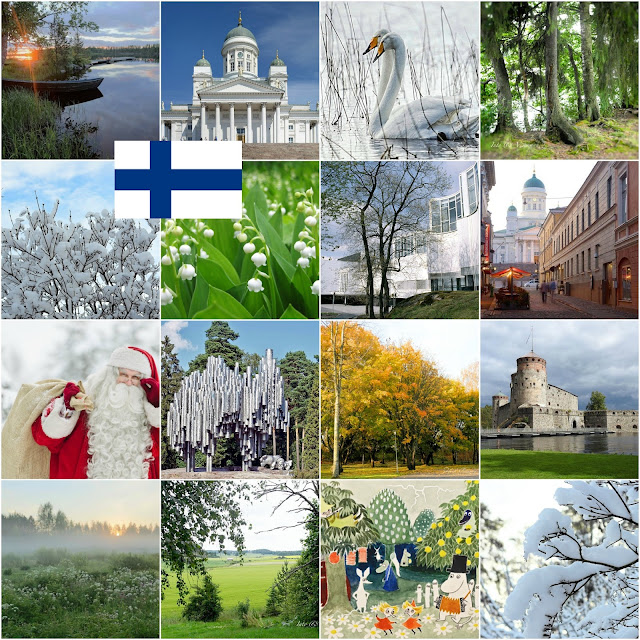
 
 
Well, despite our odd language Finland is a wonderful small country.
I'll share with you an old Finland collage.


ART FOR THE WEEKEND
I just read a biography of Mary Gallen-Kallela, the spouse of Akseli Gallen-Kallela.
My rewiev is in Finnish but there is Google translator.
Mary & Akseli had an interesting life with travels in Europe, Africa and The US.
Mary was skillful pianist but rejnounced that career.

Mary 1891

Heroic Mary 1894

My post about The Gallen-Kallela Museum / The Inner Eye
Artist of January Akseli Gallen-Kallela & his Kalevala frescoes at the Finnish National Museum

 
Mary 1905

❤︎❤︎❤︎
Wishing you all a great weekend!
Thank you for all the lovely comments you leave week after week at Friday Bliss.


The link is open
FROM FRIDAY 7 AM TILL THE NEXT TUESDAY 4 PM
Helsinki time

You are invited to the Inlinkz link party!

Click here to enter

15 lokakuuta 2019

Tuesday’s Treasures


The National Museum of Finland in Helsinki is a treasure as such, but today a few shots of the fabulous frescoes on its entrance dome. The roof of the entrance hall features Kalevala-themed frescoes painted by Akseli Gallen-Kallela (1865-1931). The frescoes painted in 1928 were modeled on the frescoes painted by him at the Finnish pavilion at the 1900 Paris World Expo.


This umbrella with the frescoes was so beautiful, but too expensive for me.

Gallen-Kallela is best known for his illustrations of the Finnish national epic Kalevala. His works in national romantic style are considered very important for the Finnish national identity. I posted about an exhibition The Inner Eye in his home museum Tarvaspää in the summer.


31 elokuuta 2019

Jenni Tieaho - The Black Swan


The Black Swan - is called the fabulous outdoor art exhibition by Jenni Tieaho (b. 1969) situated in the yard of Akseli Gallen-Kallela Museum. Inside the atelier building there is an exhibition The Inner Eye. The curator of the exhibition is Nina Kokkinen, a researcher of art and religion and the exhibition is largely based on her published doctoral dissertation. Tieaho's mythological animals fit the esoteric theme brilliantly. Btw. Cygnys cygnus is Finland's nationl bird.

Black swan and other strange visions
Tieaho's stunning sculptures show dreamlike works of swans and human animals. The materials used are mainly natural such as wood, tar and willow parts of Finland's natural plants. The starting point for Tieaho's work is Finnish mythology and mythical animals. The swan character has a lot of symbolism, beliefs and myths. In the ancient beliefs of the Baltic Sea tribes, the swan was humanized and sacred. Swan was believed to be interconnected between this world and the world beyond. In the Kalevala, a swan swims in the black river of Tuonela, and when it leaves, Lemminkäinen loses his life. Jean Sibelius has a composition under the name of The Swan of Tuonela.


Humanized / Mythological Horses 
In addition to swans, the exhibition features horse figures made up of wooden braids and milkweed autumn wool. Horse is a symbol of freedom and a bridge to the subconscious. In Tieaho's human horse characters, man gets the animal's senses and animal man's intelligence. The equine character represents the perfect merging of conscious and instinctive.


The Swan of Tuonela by Jean Sibelius


30 elokuuta 2019

Gallen-Kallela Museum - The Inner Eye


To the right: Akseli Gallen-Kallela - Kosmos / Universe


We Finns know Gallen-Kallela Museum with the name Tarvaspää. It was the atelier of the artist Akseli Gallen-Kallela (1865 - 1931) and he lived on the premises in a separate villa. The studio castle of Tarvaspää is worth a visit as such. The building was completed in 1913 and was designed by the artist himself. At that time the neighbourhood was very silent, no loud motorway nearby. The building is located on a high hill overlooking the sea and sone stairs leading down steep cliffs. Stunning building and environment!


The exhibition The Inner Eye focuses on art of the turn of the 19th and 20th centuries. Along with Akseli Gallen-Kallela, it features Pekka Halonen, Hugo Simberg, Beda Stjernschantz, Ellen Thesleff, Sigrid af Forselles and Sigurd Wettenhovi-Aspa. The curator of the exhibition is Nina Kokkinen, a researcher of art and religion and the present exhibition is largely based on her published doctoral dissertation called Seekers of Truth.


I bought myself this fabulous book by Nina Kokkinen:  Seekers of Truth.
It examines how esoteric spirituality is expressed in the art of these three painters:
Akseli Gallen-Kallela (1865 - 1931), Pekka Halonen (1865-1933) and Hugo Simberg (1873-1917).

Occultism and esoteric movements achieved unprecedented popularity in the late 19th century. Many artists were inspired by spiritualism, theosophy and the study of psychic phenomena, which came to be known later as parapsychology. Clairvoyance became one of the most fascinating topics of the period. Many people believed that the sixth sense and the inner eye of the soul made it possible to perceive the more subtle levels of reality that would normally remain unseen. Artists began to portray themselves, their friends and the masters that they admired as extrasensory seers and psychics.


Hugo Simberg - Halla / Frost 1895


Hugo Simberg - Säkkijärven poika / Boy from Säkkijärvi 1897


Hugo Simberg - Unikko / The Poppy 1896


Magnus Enckell - Pää / Head 1894


Ida A. Fielitz - Portrait of Sigrid af Forselles


Beda Stjernschantz - Madonna 1898


Pekka Halonen - Madonna 1902. Photo Nina Koskinen. My own photo was unsharp :)


Hugo Simberg - Figure in a desert & a skull, Tampere Cathedral, frescos 1904


Akseli Gallen-Kallela


Akseli Gallen-Kallela  1907


The exhibition was very interesting, although clairvoyance & spiritism are strange to myself. There were old books and photos on display and a visitor interested in esoteric things could spend hours examining them. But I admired only these great paintings, showing the best of The Golden Era of Finnish art.See also Jenny Tieaho's fabulous outdoor exhibition The Black Swan in the museum garden.

01 tammikuuta 2017

Artist of January - Akseli Gallen-Kallela

Waterfalls of Imatra 1893
Imatra is my childhood home town and I went to school over that bridge for 8 years!

As I told you before, we are celebrating this year our 100th Year of Independence. There are going to be huge celebrations throughout the year. Therefore I thought to look back to years before we reached our independence on December the 6th 1917.

Kullervo Cursing 1899

We were the Grand Duchy of Finland under Russia, before that we had belonged to Sweden. In the 19th century the Finnish language had no official status and it was confined to lower classes while the higher classes spoke only Swedish. However, throughout Europe nationalism and national romantic ideas started to flourish. Elias Lönnrot gathered oral folklore and mythology to our national epic The Kalevala, first edition in 1835. This arouse a lot of excitement also in the Swedish speaking upper classes and the Finnish language and literature started to develop.

Aino myth 1891

Due to these reasons my first artist of this jubilee year is Akseli Gallen-Kallela (1865 - 1931). He is one of our most prominent painters, a Swedish-speaking painter who is best known for his illustrations of The Kalevala. His work was considered very important for the Finnish national identity. 

Lemminkäinen's Mother 1897
On the left upper corner you can see The Swan of Tuonela that also inspired Sibelius

In addition to The Kalevala themes Gallen-Kallela painted also landscapes and portraits. In 1909, he moved to Nairobi in Kenya with his family, and there he painted over 150 expressionist oil paintings and bought many east African artefacts. Between 1911 and 1913 he designed and built a studio and house at Tarvaspää, about 10 km northwest of the centre of Helsinki. His house is now a museum and can be visited.

Lake scenery 1901

Photo: Gallen-Kallela Museum, Saana Kytömäki

How I dreamed of my own studio, large, spacious and well-lit, 
where thoughts and ideas could come of their own accord, without the pangs of labour.
- Akseli Gallen-Kallela

Wishing you all a Great New Year!